Welcome to the BEAM Blog!
... And Now for Some Math
This was a Challenge Problem last summer at our Bard College site. Malachi takes 42 pieces of candy, each of which is either a Skittles or an M&M…
This was a Challenge Problem last summer at our Bard College site. Challenge Problems encourage students to work collaboratively; once it's solved, the whole program gets a prize. (For this one, a sleepover on the last night!) So now it's your turn... can you solve it?
Malachi takes 42 pieces of candy, each of which is either a Skittles or an M&M, and arranges them in a circle letter side down (so they look identical!). He tells Hodaya that 23 of the candies are next to at least one Skittles, and 35 are next to at least one M&M. If Hodaya can figure out how many Skittles and how many M&Ms there are, she gets all of them!
How can Hodaya figure this out? (The answer appears below the image.)
Solution:
The important thing is to go step-by-step to figure out what you can.
If there are 23 candies next to at least one Skittles, that means 42-23=19 candies are not next to any Skittles — so they must be next to two M&Ms.
If 19 candies are next to two M&Ms and 35 are next to at least one M&M, that means 35-19=16 are next to exactly one M&M.
Now here's the key insight. Suppose there are x M&M's. Each M&M has a neighbor on the left and on the right, so if you add up for all the pieces how many M&M neighbors they have, you should get 2x. Well, we know that 19 candies are next to two M&Ms, so they have a total of 38 M&M neighbors. And 16 are next to one M&M, so they have 16 M&M neighbors. That gives 54 total M&M neighbors.
Divide by two to get 54/2=27 M&Ms in total.
With 42 candies in total, subtract out the M&Ms to get 42-17=15 Skittles.
Sometimes, it's amazing how much you can figure out with what seems like too little information!
What It's Like to Teach at BEAM
A faculty member from Summer Away at Bard College wrote to tell us about her amazing BEAM experience. Read about what it’s like to teach at BEAM.
Cecily Santiago, a first-year faculty member at BEAM Summer Away at Bard College, shared the following with her friends after her summer with BEAM (and we wanted to share it with you)!
This summer, I spent three weeks working as a math instructor at BEAM Summer Away. This has been one of the best experiences of my life, personally and pedagogically, and BEAM's mission is so much in line with my own values that it was a perfect fit.
Let me tell you about why I think BEAM is so awesome:
Last winter, I saw a post in a Facebook group about this job, teaching math at a three-week summer math camp. I clicked on it and immediately knew I wanted to apply for this. It didn’t pay as much as some other summer opportunities, and the application was long and daunting—they wanted a sample lesson plan! They wanted paragraphs about my pedagogical philosophy! They wanted to know how I would react in certain situations! But this didn’t deter me—their focus on excellent math education as a vehicle for social justice was right up my alley. My goal in life is to give the world a group hug using mathematics, and this was an opportunity to work on that goal.
BEAM finds their students from the most underfunded school districts in NYC and LA, testing their ability for abstract problem solving regardless of academic preparation. For those who shine, they run a day camp the summer after 6th grade and a sleep away camp the summer after 7th grade. Here, they teach math in a fun and accessible way, helping to strengthen the kids’ skills in school math, like fractions, but also giving them exploratory courses in math that few people who aren’t math majors ever get to see, working on their ability to reason, prove, and generalize. After these camps, students continue with Saturday Classes, with specialized support for getting into other math programs and competitive high schools. Throughout high school and even into college, the program supports these kids on their academic journeys, giving them the tools, resources, and information necessary for them to excel as students and preparing them to enter math-related careers if they choose to. I applied to be Junior Faculty at the summer camp.
BEAM students work on toppling sandpiles in Cecily’s class.
The next step was a TWO HOUR video interview. I emphasize the application and interview process so much because it indicates how much BEAM cares about finding excellent people to staff their camps. Even the counselors, who were not teaching, went through a similar process. It wasn’t just an interview—it was a conversation. This is also typical of BEAM—they are collaborative and appreciate feedback and input from students and staff alike. Nothing is ever a certain way “just because.” There is always a reason, usually a good one, and if things can be done better everyone works together to find a better way.
I was offered the position and enthusiastically accepted! I finally met some of the BEAM staff on a planning retreat in NYC in May, and it was so amazing to be around people who care so deeply about math education. In many ways, I felt like I’d found my people. The staff come from a wide variety of backgrounds, intellectually and socially, but they are all united in how much they care, how much good they want to do, and how humble they are as they do it. Everyone was working incredibly hard, with passion and joy, and no one was patting themselves on the back.
When I arrived at Bard College, the “Summer Away” site that hired me, I was nervous about working with 13 year olds and didn’t know what I should expect in the classroom. I knew that these kids had an affinity for math, but I also knew their math background was lacking. I knew I was supposed to plan fun, engaging, somewhat rigorous, and very inquiry-based courses, but I didn’t know if the students would want to be engaged. I had never planned a course like that—in fact, I had never planned a course about something I wanted to teach, or planned a course completely from scratch, or planned a course that was in line with how I believe math should be taught.
Turns out my fears were unfounded. The kids were AWESOME. They started off shy, but soon they were all shining with their vibrant and unique personalities, befriending each other and the staff alike. In the classroom, they were interested and engaged and insightful. Every single one of them pushed themself to grow and learn and come out stronger than they came in. They all started in different places and they all ended in different places—although these students are all strong mathematical thinkers, some had better preparation coming in and some had more intuition for certain aspects of math than others—but every single one of them ended as a better mathematician, and probably also better future-adult than they came in as.
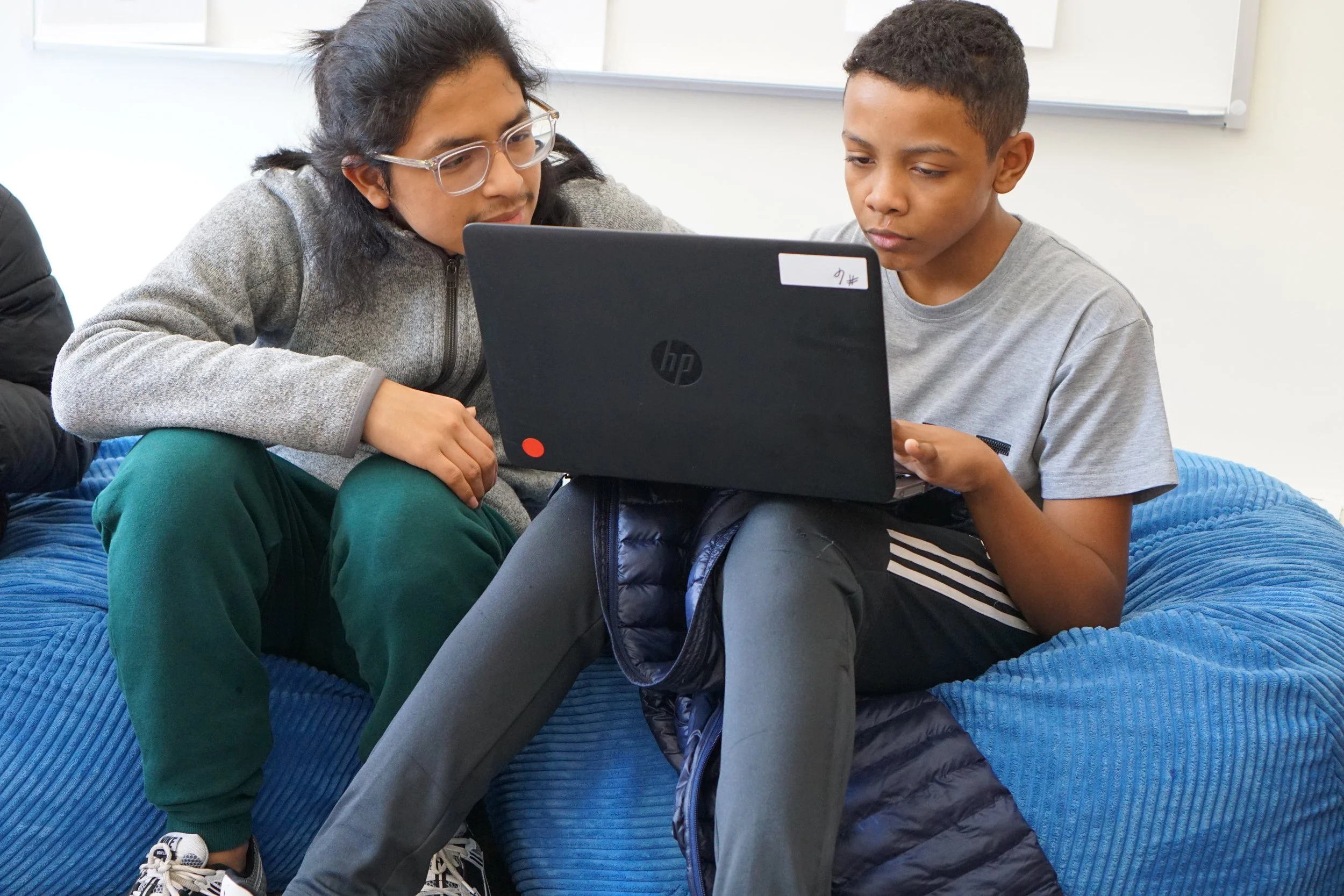
Cecily works with a BEAM student.
Teaching was amazing. I taught a course on Sandpiles and another on Sets. I learned so much about how to run a classroom. I got to teach at the pace that was right for the students. I got to take the whole class down unplanned avenues that sparked their interest. I got to interact personally with every student. I got to create games and challenges that supported the course material. I got to make learning a truly fun adventure. I walked away from almost every class with a happy glow. I was given so much freedom, but also a lot of support and feedback. This isn’t just a place for students to grow—this is a place where adults grow too.
Discipline here was really interesting, and different in some significant ways than any other model I’ve experienced. While there were systems and consequences, there were only four rules. Honestly, the first three are now my personal rules for life.
Be here to grow
Be excellent to one another
Don’t do stupid stuff
Follow staff instructions
Pretty much any behavior that we would want to discourage falls into the first three rules. You called another student a mean name? You’re not being excellent. You slacked off during class? You’re not being here to grow. You jumped down a whole flight of stairs? You’re doing stupid stuff. And then number four is a catch all. You’re only eating fries for dinner? I’ll tell you to go back and get some veggies. You refuse? You’re not following staff instructions.
But moreover, the way we handle the kids when they break the rules is, to me, revolutionary. We don’t say “Hey, Dan, stop that! I’m reporting you!” We treat them as future adults rather than as just kids. We would say “Hey, Dan, do you know why I came over to talk to you? Do you think that you’re being excellent right now? Why or why not? Have we talked about this before? Why did you choose to take this action? What could you do better next time? Do you think that reporting you would be an appropriate punishment? What do you think would be appropriate?” We ask them to reflect and learn from their behaviors. When a kid is reported too many times, we have a serious discussion with them. There are ways to get reports taken off your record, if you behave well enough for long enough after something happened. There are more serious consequences if patterns of behavior don’t change, especially if they make the camp unpleasant for the other students, but we start by acknowledging that kids can reflect and make choices and decide how they want to act, and that kids will one day be adults who will need these skills in life.
There is so much more I could say about why I am completely in love with this program, but I just want to emphasize how utterly rare and amazing this organization is. As far as I know, nothing else like it exists. They get everything right, from selecting students to selecting staff, from pedagogy to discipline, from site leadership to overarching structure, from an individual class to a lifetime of support. The students and staff alike thrive here, and I am certainly planning to come back.
Thank you BEAM supporters!
Thanks to everyone who has contributed to BEAM!
Now that our summer programs are over, our students would like to tell you what they accomplished.
“I solved a lot of challenge problems with my friends.” —Ruth, BEAM Discovery
“I solved 12 problems in the 100 Problem Challenge.” — Vernon, BEAM Discovery
“I learned some coding and got WAY better at it. BEAM made me love math and realize my passion for it!” —Mia, BEAM Discovery
“This is my first ever program and I loved it! I’m glad that you helped support BEAM.” —Hayden, BEAM Discovery
“BEAM helped me see math in a whole different way. THANKS.” —Sanjana, BEAM Discovery
“BEAM is a glowing star.” (left) —Estefani, BEAM Discovery
“BEAM is out of this world.” (right) —Allison, BEAM Discovery
BEAM Summer Away at Bard Week 1!
Week 1 at BEAM Summer Away at Bard!
Week 1 at Bard was great!
Tuesday through Saturday, students attended classes of their choice. First week classes included Geometry, Cryptography, Number Theory, Paper Folding, Solving Big Problems, and Math Team Strategies.
Adri and Zhixing work on problems involving triangles in Geometry.
Students also participated in a variety of activities, from basketball, to making a solar oven, to playing Ricochet Robots, to Billie Eilish appreciation. In addition, there was a five-mile hike and a trip to Zoom Flume Water Park!
Stay tuned for week 2 news!
Fun at the waterpark
Fieldtrip to the waterpark!
Students at BEAM Summer Away Union College enjoy a day at the waterpark!
Mathematician Edray Goins Visits BEAM at Harvey Mudd
Edray Goins Visits BEAM Harvey Mudd
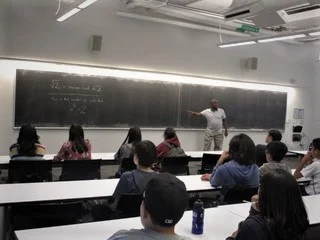
This weekend, Dr. Edray Goins, mathematics professor at Pomona College, gave a brilliant talk to students and faculty at BEAM Summer Away at Harvey Mudd College. Dr. Goins grew up in Los Angeles just like our students and graduated from two of the best universities in the country, California Institute of Technology and Stanford University. Dr. Goins explored with students how the geometric mean and recursive sequences of numbers can be used to find an algorithm for square roots. Students left not only inspired to continue their journey in mathematics, but also driven to keep learning new techniques in math. BEAM students Maxine and Karla said of Dr. Goin’s presentation: “Many new ideas and theories were presented in a way that was straight forward and precise.”
Thank you, Dr. Goins, for truly inspiring us!
Interested in getting to know Dr. Goins better? Check out this profile of him, featured in The New York Times in February.
BEAM Summer Away begins in California
BEAM Summer Away CA at Harvey Mudd College is off and running!
BEAM Summer Away California at Harvey Mudd College is off and running!
On Sunday, there was an excited energy as counselors and staff got to know students and their families. Next on our to-do list were dorm tours. Students were eager to pick out their bunk beds and unpack. Then, students explored the campus, reconnected with BEAM friends from last summer, and started making new friends.
Last, but definitely not least, the Rock, Paper, Scissors tournament kicked off with faculty and staff joining in!
Next up, the marvelous world of mathematics … Stay tuned to learn more!
BEAM Pathway Program Family Lunch
On Saturday, May 4th we welcomed newly admitted BEAM Pathway Program students to the program with our annual Family Welcome Lunch. Students and their families got the chance to meet the BEAM full time and summer staff, other admitted students and learn more about what to expect at a summer away on a college campus. Additionally, we invited BEAM alumni and parents to come share their experience during the summer. Check out some pictures from the event below:
If you missed out on a chance to attend the lunch or are interested in the presentation. Check out the video below:
Infinities, Graph Theory, Game Theory, and Traveling Circuses: What Mathematicians Talk About When They Visit BEAM
This winter, BEAM is busy! We are busy hiring summer faculty, summer counselors, and other summer staff and even a few full time staff. But those aren’t the only positions we are looking to fill. Every summer we invite guest speakers to BEAM Summer Away and BEAM Discovery sites. Our invited speakers are talented mathematicians from around the world, and their talks are a window into the work of professional mathematicians, giving students an opportunity to learn new ideas from the wide world of mathematics. Some past speakers have focused on complex mathematical topics, while others share their day to day life as career mathematicians. As we line up further intriguing talks for this summer, now is a great moment to reflect on some of the lovely talks and mind-bending math our guest speakers shared with us last summer.
This past summer our guests included Dr. Edray H. Goins, Dr. Susan Loepp, Tai-Danae Bradley, and Darleen Perez-Lavin. They each presented a unique take on a mathematical topic and BEAM students got a kick out of what they had to share.
Edray confronted a complicated topic: infinities and cardinality. Though this topic is deep and challenging even for mathematics majors at top colleges and universities, Edray balanced the abstract ideas with concrete examples. He started with basic ideas and questions: What is a set? How can you count things in a set? How many subsets are there in a set with n elements? Then the talk got more abstract, and Edray lead students through a very enjoyable explanation of Cantor's famous theorem. Students had the chance to see how much there is to the mathematical world than just numbers, equations and geometry formulas.
BEAM values having guest talks that start out very friendly to students and then go off the deep end in mathematics a bit because they allow students to see just how serious and deep math can be!
Dr. Edray H. Goins is a Professor of Mathematics at Pomona College in Claremont, CA and president of the National Association of Mathematicians. Edray presented at BEAM Discovery Los Angeles.
Dr. Goins presents to the students at BEAM Summer Away during Vassar 2016. Edray has been a guest speaker at BEAM for three straight summers!
Dr. Susan Loepp, Chair and Professor of Mathematics, Williams College. Susan presented at BEAM Summer Away at Union College.
Susan introduced a team game that involved wearing hats. It costs money to play, but if you win, you get the cost doubled back. Will you win or lose money in the long run? Susan gave student volunteers a chance to play the game (not with real money) and think about optimal strategies. After a lot of trial and error (and some inadvertent cheating), students claimed to Susan that they could win 50% of the time. But she said they could do better! The rest of the talk focused on independent and dependent probability and how those concepts impact game theory. Students found the session fun and silly, yet thought provoking. Many were still talking about it the next day!
Tai-Danae came into the room with lots of brightly colored cubes. The purpose? The Instant Insanity puzzle. Everyone got four cubes with each face colored in one of four different colors. The question: can you make a stack four cubes tall so that each side of the stack has one face of each color? With over 80,000 possible configurations, this is a big challenge, but using the tools of graph theory you can solve it quickly! If you're curious, Tai-Danae also presented it on PBS Infinite Series and you can take a look and try it yourself.
Tai-Danae Bradley is a PhD candidate in mathematics at the CUNY Graduate Center, and creator of the intriguing math blog: https://www.math3ma.com/. Tai-Danae presented at BEAM Discovery NYC Uptown.
Darleen Perez-Lavin is a SMART fellow and graduate student at the University of Kentucky. Her talk was based on quantum computing research at Fermi National Accelerator Laboratory. Darleen presented at BEAM Summer Away at Union College.
Darleen gave a presentation on the Traveling Circus Problem, a more general version of the well-known and very difficult Traveling Salesman Problem (so well known and difficult that the University of Waterloo has a whole website devoted to it). Darleen presented new research on how this problem is related to quantum physics. Her talk gave a glimpse into how pure mathematics can have applied applications. The ideas jumped from Euler's solution to the Seven Bridges of Königsberg problem to talking about modern physics! Students interested in applied mathematics were especially fascinated.
We can’t wait to see all the amazing talks that this upcoming summer has in store. And if you enjoy cool math (and aren’t quite as busy as BEAM is at the moment), we encourage you explore the topics touched on in the talks above.
BEAM students play a game during Dr. Susan Loepp’s math talk at BEAM 2018.